In chromatography a peak may be an identity. The LUMA detector's 12 VUV bands appear to carry molecular structure — and we're exploring whether a spectral library could let a GC + LUMA reach toward DHA-class analysis and beyond, reading physical properties of a sample from the detector you already own. Early, exploratory work, openly under development.
Detailed Hydrocarbon Analysis normally means a 100-meter column and a multi-hour run. We're exploring whether MAI-Alchemy could approach that kind of speciation from the detector you already have — and read physical properties alongside it. Because the real question isn't just "what's in it?" — it's "what might you do with it?"
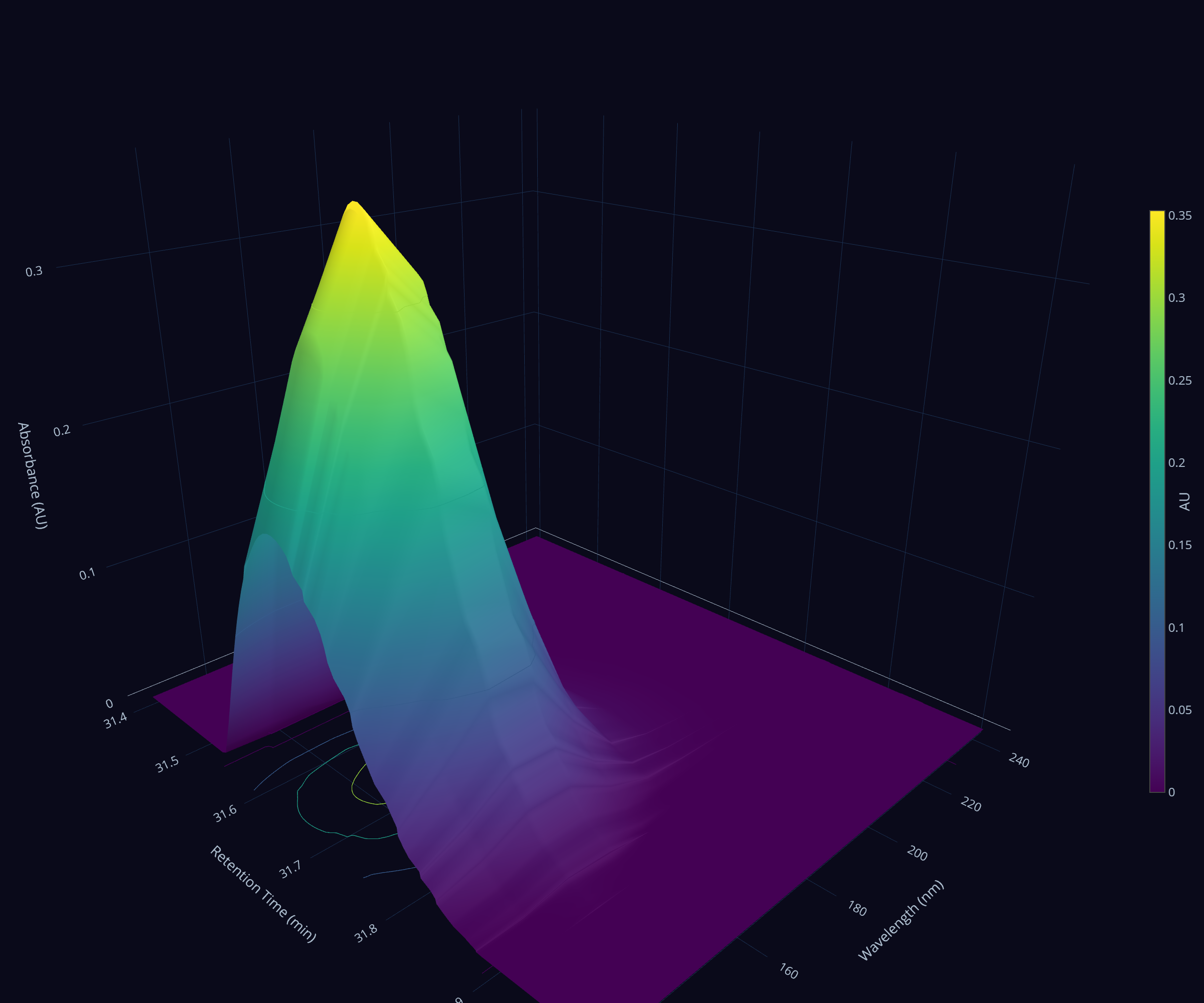
Time × wavelength × absorbance. Coelutions, shoulders and spectral shifts that hide in a 2D trace can become far easier to see.
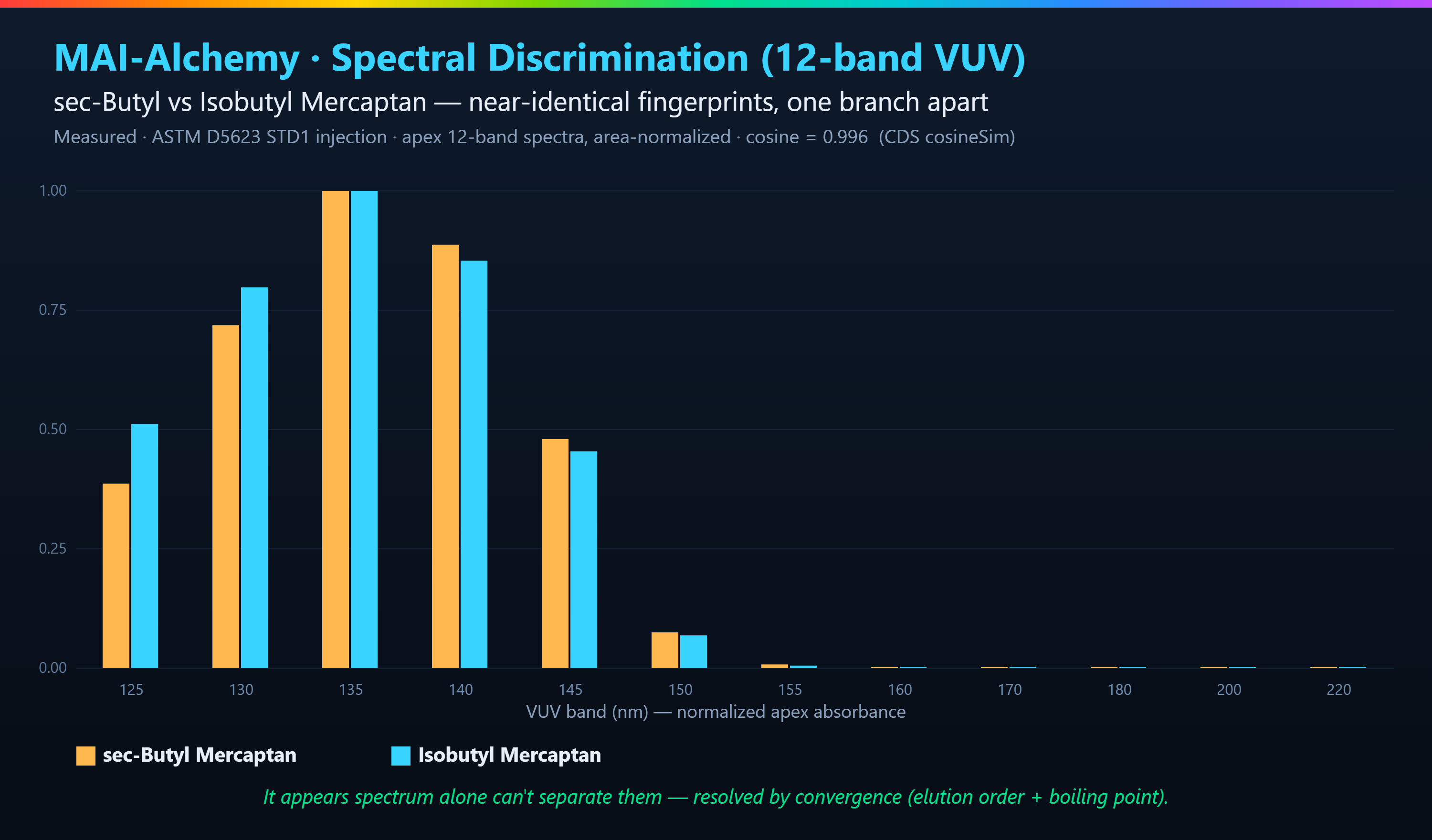
On the data we've run, twin mercaptans measure ~99.6% similar (cosine) — a case where spectrum alone can't decide. We're exploring whether physics (elution order + boiling point) could make the call instead.
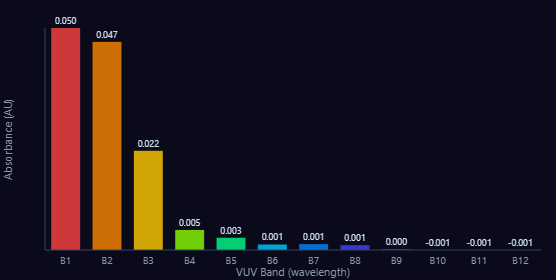
Could boiling point, retention index, response factor and density be read from the spectrum, family by family? An early, physics-anchored direction — validated against certified standards, not yet a finished, calibration-free result.
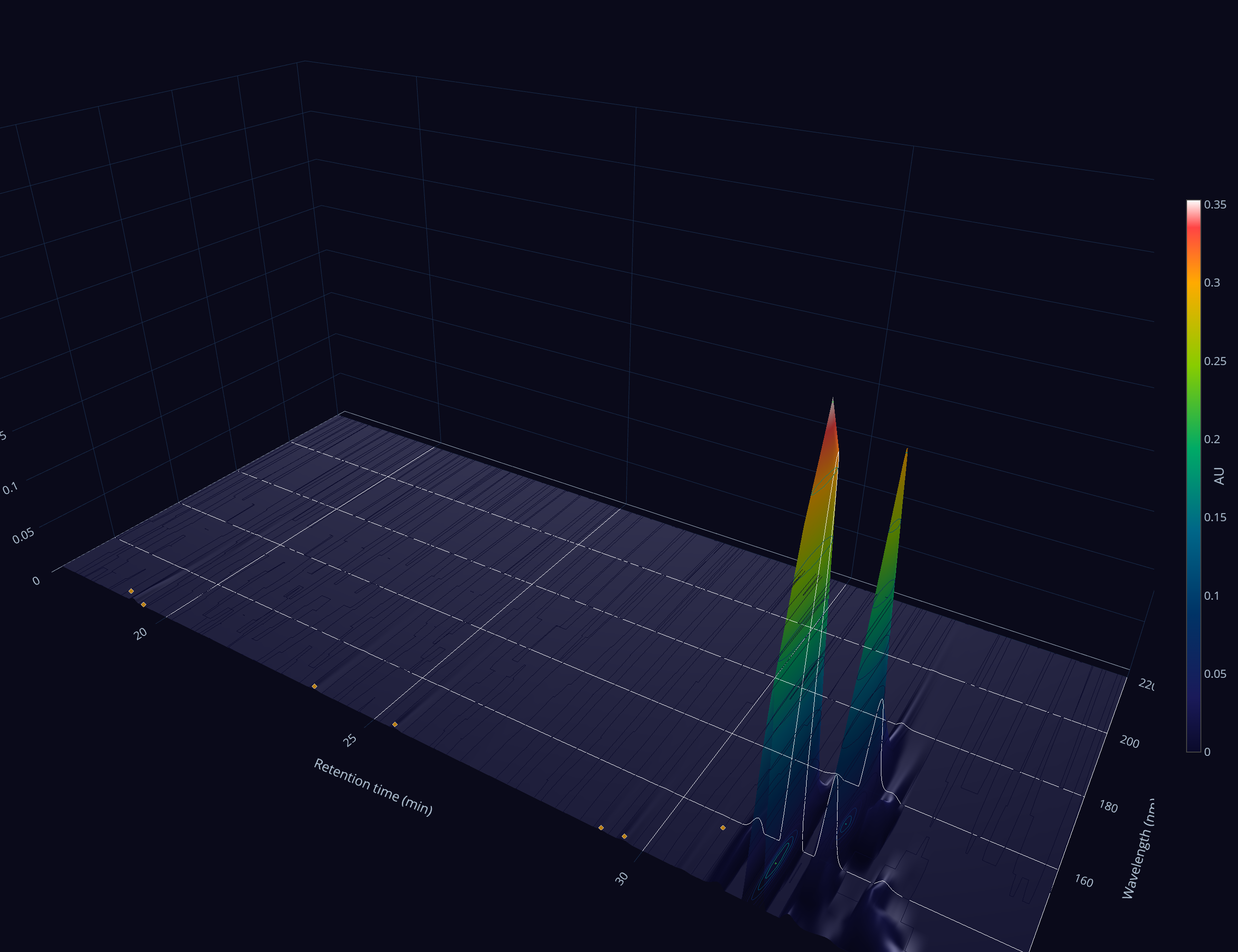
Every wavelength, every retention time, in one Stark surface — a way to view the structure of the entire run at a glance.
The Concept loads real GC-VUV data right in your browser. Pick a sample, click a peak, rotate it in 3D, and see the physical properties MAI-Alchemy is exploring how to read from the spectrum — an early taste of where the work is heading.
Every vendor system is a single-technique silo — Chromeleon, Empower, OpenLAB. MAI-Alchemy is exploring the opposite: a technique-agnostic data platform that aims to read a raw signal as molecular structure, and to learn from every analysis it runs. It began with the VUV LUMA detector — an innovative technology rich with information that appears underused — and the architecture is being designed so it needn't care what instrument the signal came from.
What the LUMA detector taught me about reading analytical data — and where it goes next. See the full journal →
The most information-rich detector in your lab is also the least understood. What it really sees, why it matters, and what becomes possible when you can finally read all 12 bands.
Why it exists, what makes it different from every other chromatography data system, and where the platform is going next — from the chemist who built it.
I'm an analytical instrumentation chemist with 33 years in the laboratory — across petrochemicals, refining, and research, for companies like Chevron, ExxonMobil, Caleb Brett, and Inspectorate. My specialty is analytical instrumentation method development: taking a measurement problem no one has cracked and building the method — on whatever instrument it takes — that finally makes it routine.
I gravitate toward being first. Most recently that's meant mastering the VUV LUMA detector — the most information-rich, and least understood, detector of its kind. But the detector was never really the point. The point was what I kept hitting in every lab, on every instrument: the software was never built for how a chemist actually thinks. We export to Excel to process the data "right." Every vendor system is a single-technique silo.
So I started building MAI-Alchemy — the analytical software I always wished I had. Not another silo, but an attempt at a technique-agnostic platform that reads a raw signal as molecular structure and could learn from every analysis it runs. It started with LUMA because it's an innovative technology whose richest information appears untapped; the vision is bigger — one place to process all analytical data, designed by a chemist, the way the chemistry demands. It's early and openly under development. Medrado Analytical Innovations, LLC is where that vision lives now.
I'm one chemist with a clear picture of what analytical data processing should look like — and an early, working prototype that begins to explore it. What comes next is bigger than one person. I'm looking for partners to build the vision out and discover where it can go.
Your detector produces rich data most software throws away. Let's explore whether it can be read as identity, properties, and structure — and see what that might do for your hardware on the bench.
Bring a hard problem — a co-elution, an unknown, a method you can't make routine. Let's run your real data through Alchemy and see what it surfaces.
The platform is patent-pending and early — a real prototype, openly under development. If you see the same future for analytical software that I do, let's talk about developing it together.
The next layer we're exploring: physics-informed chemometrics that could do more than fit a model — aiming to explain itself in the language of the chemistry — per-family behavior, confidence you can reason about, and outliers you can act on. Early and under development. Patent pending.
Send a note and I'll get back to you personally.